



As your business grows, the question isn’t just how to scale — it’s who will scale it with you.
Should you build your own in-house team or hire a dedicated external team through a partner? Both paths have merit, but each fits different business stages and priorities. This article breaks down the models, their pros and cons, costs, and gives you a practical framework to make the right choice.
1. The Growth Dilemma
Every growing tech company faces a familiar turning point: the product is gaining traction, the backlog is piling up, and the internal team is stretched thin.
Do you keep hiring internally — investing in your culture, infrastructure, and long-term capacity — or bring in a dedicated external team to scale faster?
This decision shapes your speed to market, cost structure, and control over execution. Done right, it accelerates growth; done wrong, it can drain resources and dilute focus.
2. Understanding the Models
In-House Team
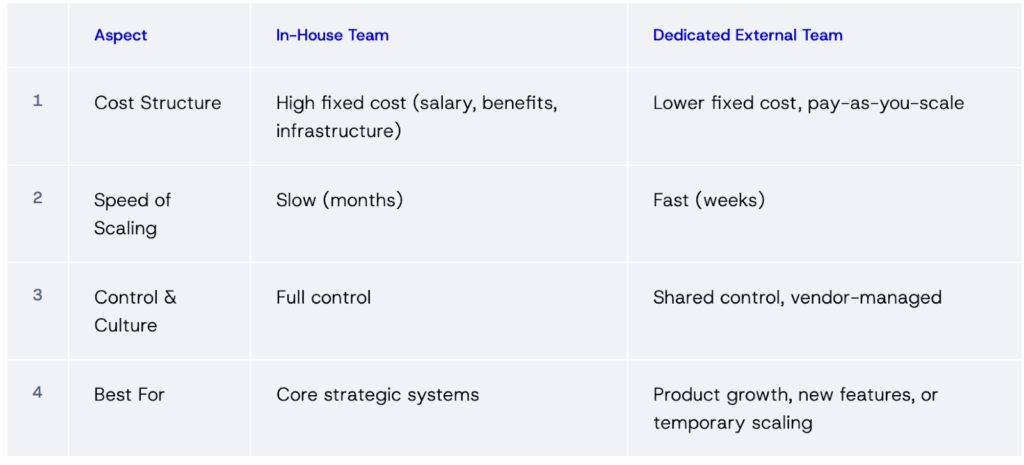
An in-house team means employees fully integrated into your company: recruited, onboarded, and managed internally.
You control everything — from hiring standards and processes to culture and long-term development.
Best for:
- Core product and IP-heavy work
- Stable, long-term roadmaps
- Companies with predictable budgets
Key characteristics:
- High control and cultural alignment
- Slower ramp-up
- Higher fixed costs
Dedicated External Team
A dedicated team is a group of professionals provided by a partner (vendor) who work exclusively on your product but are legally employed and managed by that vendor. You control the backlog and priorities; the vendor handles hiring, HR, and payroll.
Best for:
- Rapid scaling during growth phases
- Projects with changing scopes
- Companies needing specialized expertise
Key characteristics:
- Faster scaling and onboarding
- Variable cost model
- Medium control with shared governance
Model Comparison

3. Market Data & Insights
Statistics highlight why more companies are rethinking their scaling approach:
- The true cost of hiring in-house IT staff is 1.25–1.4× the salary, factoring in benefits, infrastructure, and taxes
- Onboarding internal hires takes up to 50% longer than integrating a dedicated team
- Companies using dedicated teams achieve ~21% faster time-to-market due to rapid scaling and reduced recruitment overhead
These trends reflect a shift in the global IT landscape: hybrid collaboration models are becoming the new normal.
4. Pros and Cons
In-House Team
Pros
- Full control over priorities and processes
- Deep product and domain knowledge
- Strong cultural and communication alignment
- Direct retention of intellectual property
Cons
- High long-term costs
- Difficult to scale quickly
- Recruiting bottlenecks, especially for niche skills
- Risk of stagnation without external innovation input
Dedicated External Team
Pros
- Quick setup and flexible scaling
- Cost-efficient (no benefits or office costs)
- Access to specialized or rare expertise
- Vendor handles HR, retention, and infrastructure
Cons
- Less cultural alignment at first
- Dependence on vendor performance
- Possible communication overhead
- Requires clear governance and integration
5. Decision Framework
Use the matrix below to evaluate which model fits your current stage:

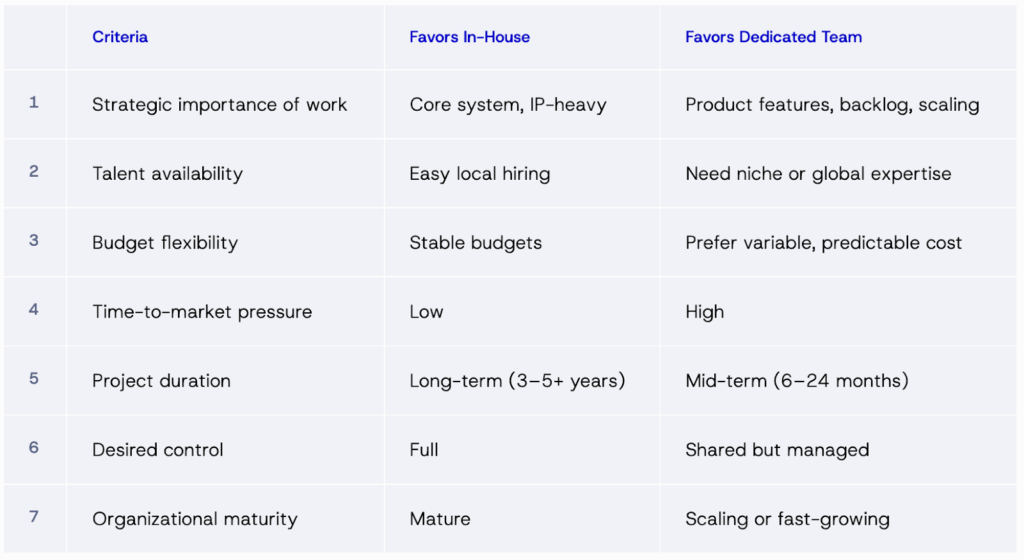
When to Build In-House
- You’re building a strategic core product where long-term IP retention matters.
- You can afford slower hiring cycles and want to invest in internal growth.
- You have a stable, predictable roadmap with little fluctuation.
When to Hire a Dedicated Team
- You need to scale fast and fill skill gaps (e.g., DevOps, AI/ML, security).
- You want flexibility to ramp up or down based on demand.
- You’re in the growth phase or exploring new verticals where experimentation speed matters more than ownership.
6. Cost & Scalability Considerations
Cost efficiency isn’t just about hourly rates — it’s about total ownership.
- In-house: Higher upfront and long-term costs; less flexibility.
- Dedicated team: Lower setup cost and faster scaling; slightly less control.
According to Leobit, companies save up to 30–40% by choosing a dedicated team over in-house hiring for short-to-mid-term projects.
Dedicated models also reduce the time to assemble a team by 30–50%, which can make or break competitive product launches (Key-G).
However, hidden costs exist in both models:
- In-house → HR overhead, retention risk, training, infrastructure.
- Dedicated → Vendor lock-in, knowledge transfer complexity.
The best ROI comes when your model aligns with your growth horizon and workload predictability.
7. Implementation Tips
For In-House Teams:
- Invest in structured recruitment and mentorship programs.
- Build knowledge bases to retain product expertise.
- Prioritize team morale and retention early.
For Dedicated Teams:
- Choose a vendor with proven communication transparency.
- Integrate the team into your product culture and agile sprints.
- Establish clear KPIs, governance, and escalation paths.
- Conduct quarterly reviews and ensure documentation for knowledge transfer.
For Hybrid Models:
- Keep your core (architecture, strategy) in-house.
- Delegate feature development or scaling to a dedicated team.
- Use shared tools (Jira, Slack, Notion) and clear communication channels to maintain cohesion.
8. Emerging Trends
The post-pandemic IT world favors flexibility and global collaboration:
- Remote work normalized hybrid setups — dedicated teams are now a strategic choice, not a cost compromise.
- Talent shortages (especially in AI, cybersecurity, and cloud) make dedicated partnerships essential.
- Startups and scale-ups increasingly begin with dedicated teams, then transition core functions in-house once stable.
As Forbes noted in 2024, over 64% of tech firms use at least one external dedicated team model, blending cost efficiency with control.
9. Conclusion
Scaling isn’t just about adding people — it’s about aligning your growth model with your strategy.
- Choose in-house if control, culture, and long-term continuity matter most.
- Choose a dedicated team if speed, flexibility, and access to talent drive your growth.
- Or blend both for strategic balance.
The smartest leaders scale not by hiring faster, but by building smarter partnerships.
Scale smart, not just fast — the right team model will support your growth without draining your budget or control.