
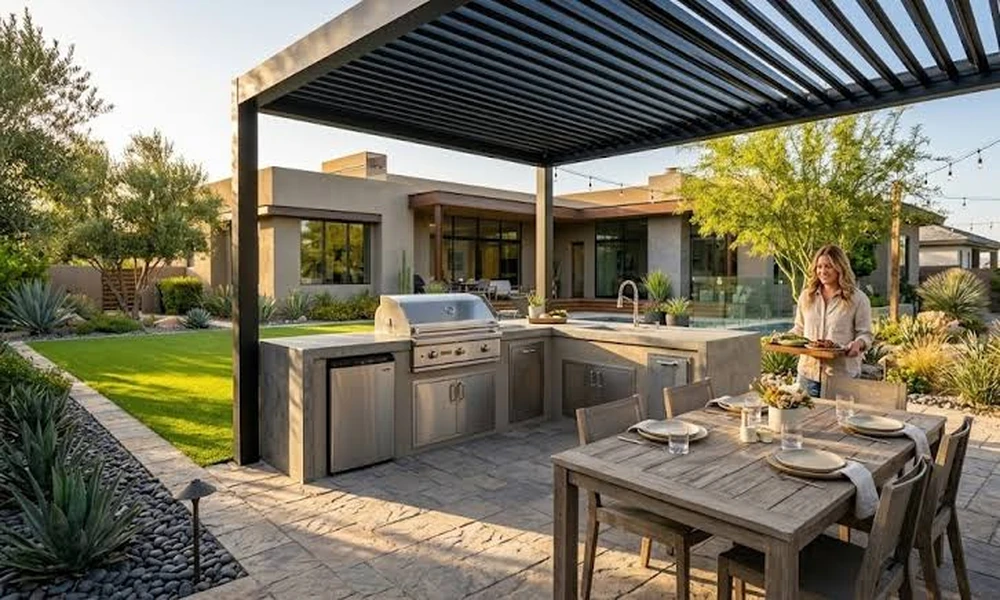
Most homeowners think about their backyard in one of two ways: either as a project they’ll get to someday, or as a space they use and enjoy right now. What very few people think about is the third dimension sitting quietly underneath both of those: the dollars that outdoor design adds to, or quietly drains from, a home’s appraised value. That gap in thinking costs people real money when they sell.
The good news is that the relationship between backyard design and home value is measurable, and the data points in a clear direction. This article breaks down what actually moves the needle, what doesn’t, and how to make smarter decisions before you start digging.
The ROI Gap Between “Nice Yard” and “Designed Yard”
There’s a meaningful difference between a maintained yard and a designed one, and buyers feel it the moment they pull into the driveway. A maintained yard says “the owners take care of things.” A designed yard says “someone made deliberate choices here,” and that signals quality throughout the entire property.
According to the National Association of Realtors’ 2023 Remodeling Impact Report on Outdoor Features, standard lawn care returns 217% of its cost at resale. That’s an exceptional number. But the return on a professionally designed landscape, which layers plant selection, hardscaping, and spatial flow into a cohesive plan, compounds that base number by making the entire property more competitive in its local market.
A Virginia Tech Extension study found that upgrading landscaping from average to excellent can increase a home’s perceived value by 10% to 12%. On a $450,000 home, that’s $45,000 to $54,000 in added value, often for an investment that costs a fraction of that figure.
The key word there is designed. Planting a few shrubs and calling it done isn’t the same as a plan that accounts for sight lines, seasonal color, irrigation, and how the space connects to the interior of the house.
Three Zones Where Design Decisions Matter Most
Not every part of your outdoor space carries equal weight with buyers or appraisers. After studying the data, I think about a property’s outdoor value in three zones, which I call the Three-Zone ROI Framework:
- Zone 1 – The Street Read: Everything visible from the curb. Lawn condition, driveway edges, entry plantings, and tree canopy. This zone influences whether buyers even schedule a showing.
- Zone 2 – The Transition: The path from the front door to the backyard gate. Lighting, paving materials, fencing, and side-yard condition. Buyers experience this zone in the first 90 seconds of a showing, and it sets every impression that follows.
- Zone 3 – The Living Space: The backyard proper. Patio surface, plant structure, shade, and any built features like pergolas or garden walls. This zone drives the emotional decision to buy or pass.
Most people only invest in Zone 3, because it’s where they spend their time. Smart sellers invest in all three, because buyers evaluate them in reverse order: street read first, living space last.
What the Data Actually Says About Specific Projects
The table below pulls ROI figures from the NAR’s 2023 Outdoor Features report. These are national averages, so local markets will shift the numbers, but the relative ranking holds across most regions.
| Project | Estimated Cost | Estimated ROI at Resale |
|---|---|---|
| Standard lawn care (maintenance) | ~$4,800/yr | 217% |
| Landscape maintenance (pruning, mulch) | ~$3,000/yr | 104% |
| Irrigation/sprinkler system | ~$5,000 | 83% |
| Outdoor kitchen | ~$15,000 | 100% |
| Patio/paved area | ~$10,000 | 95% |
| Landscape lighting | ~$4,000 | 59% |
The pattern here is worth sitting with. Maintenance consistently outperforms big one-time installs on a pure ROI basis. But the projects that buyers remember, and that set a home apart in a competitive market, are the designed ones. A high-quality patio with a pergola and cohesive plantings gives buyers a specific reason to choose your home over the one two streets over with a bare concrete slab.
“Curb appeal can be a huge factor when selling a home.” – Craig Steinley, president of the Appraisal Institute, quoted in a 2024 industry analysis on landscape value and residential appraisal.
Steinley’s point isn’t theoretical. Appraisers look at comparable sales, and a property with a professionally designed outdoor space competes favorably against comps that don’t have one. That’s how design decisions get baked into the appraised value, not just the sale price.
The Central Valley Reality Check
Anyone designing a backyard in California’s Central Valley is working with a specific set of constraints that generic national data doesn’t address. The summers in the Modesto area regularly exceed 100°F, the soil runs from heavy clay to sandy loam depending on the neighborhood, and water costs are a genuine concern that a buyer will factor into their carrying costs.
That context changes the design calculus. A shade structure paired with drought-tolerant plantings isn’t just an aesthetic choice here; it’s a practical one that buyers recognize and value. Automated drip irrigation signals to buyers that the landscaping is manageable and won’t spike their water bill. Native and climate-adapted plants communicate low maintenance, which matters to busy families who aren’t interested in weekend yard work.
These are the kinds of design decisions that a local professional makes by default, because they’ve seen what survives and what doesn’t through a Central Valley summer. That local knowledge is genuinely hard to replicate with an online planting guide. When you work with Landscape Design Services in Modesto CA, the design isn’t just visually planned; it’s planned for the climate, the soil, and the specific demands of this region.
The Job Market Signal Most Homeowners Miss
Here’s something most people don’t consider: the professional landscape design industry is growing, which means the supply of qualified designers is actually somewhat constrained. According to the U.S. Bureau of Labor Statistics’ Occupational Outlook Handbook (2025 edition), employment of landscape architects is projected to grow 3 percent from 2024 to 2034, roughly in line with the overall job market, but demand from homeowners continues to climb. That gap between growing demand and steady supply puts a premium on firms with established processes and experienced crews.
What that means practically: if you’re planning a design project, booking earlier in the season gives you access to the best teams. The firms doing quality work are rarely idle.
A Practical Planning Framework Before You Call Anyone
Before you pick up the phone for a design consultation, spend 20 minutes doing this:
- Walk your three zones with your phone camera. Take a photo of each zone from the buyer’s perspective: from the curb, from the front door, and from the patio. What you see in the photos is what a buyer will see. It’s usually more revealing than you expect.
- List the one thing that bothers you most about each zone. Not everything, just one item per zone. This prevents scope creep during the design consultation and helps a designer prioritize fast wins.
- Set a rough budget range, not a hard number. A range gives a designer room to offer options. A hard cap sometimes eliminates creative solutions that would have served you better.
- Check your HOA rules, if applicable. Some communities restrict fence heights, plant species, or hardscape coverage ratios. Finding out early saves everyone time.
These four steps take less time than scrolling Instagram for inspiration, and they produce far more useful input for a design team.
How Much Should You Actually Spend?
A useful rule of thumb, backed by the Home Improvement Research Institute’s 2026 spending data, is that yard, garden, and outdoor projects cluster between $12,000 and $14,000 on average for completed projects in 2026, according to HIRI’s February 2026 report. That range reflects what typical homeowners are actually committing to, not aspirational budgets. If your scope is modest, a focused Zone 1 refresh can run well under that. A full three-zone redesign will run over it. Both can return more than their cost if the work is done well.
The worst outcome isn’t overspending. It’s underspending on execution. A cheap patio with poor drainage, mismatched materials, or plants selected without regard for the climate creates a liability instead of an asset. Buyers notice. Appraisers notice. And the cost to fix it later is always higher than doing it right the first time.
Your backyard is either working for your home’s value or working against it. The question worth answering now is which one it’s doing.