
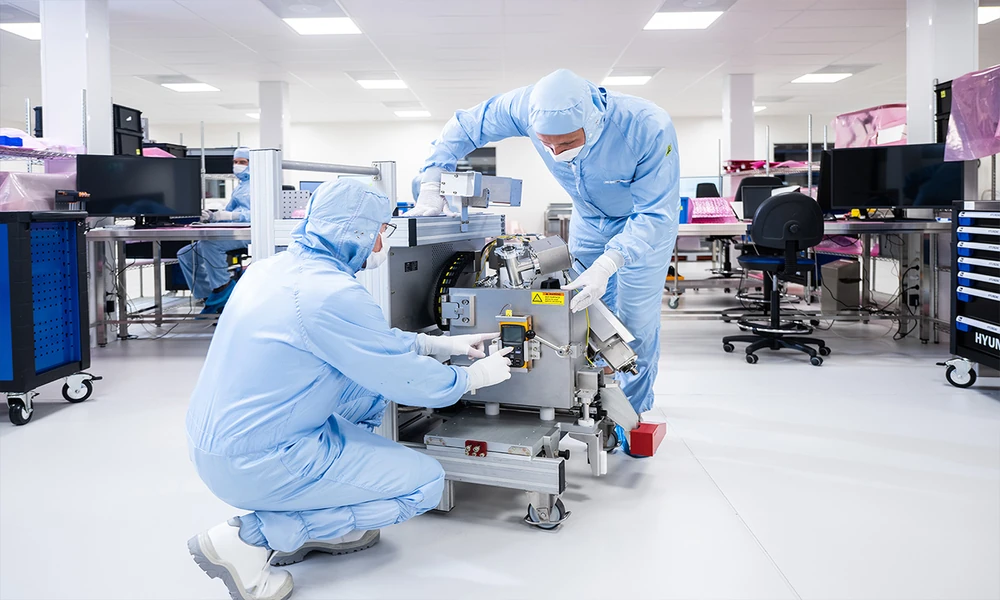
Medical clean room assembly brings together two disciplines that separately are well understood but together define the quality standard for the most sensitive medical device production work: the precision required to assemble small, complex components correctly, and the contamination control required to do so in an environment that does not introduce particulate or microbial contamination into the finished device.
For medical devices that will contact sterile body sites, be used in surgical procedures, or be implanted in the human body, the assembly environment is as much a part of the device specification as the components themselves.
What Happens in Medical Clean Room Assembly
Medical clean room assembly takes place within an ISO 14644-1 classified environment maintained at a positive pressure relative to surrounding areas, with HEPA-filtered air supply and defined entry and exit protocols. Within this environment, trained operators wearing clean room garments, gloves, masks, and hair covers perform the assembly steps using clean room-compatible tools and fixtures.
The assembly steps vary with the device but typically include:
- Component incoming inspection and identification verification against the device’s bill of materials.
- Sub-assembly of components into the sequence required by the assembly procedure.
- Torque-controlled fastening, bonding, or other joining operations performed to documented force or process specifications.
- In-process inspection at defined checkpoints where dimensional or functional verification is required during assembly.
- Final assembly inspection against the complete device specification.
Documentation and Traceability
Every assembly operation is documented in the Manufacturing Record for the device lot. The record captures which components were used (by lot or serial number where required), which operators performed each step, the results of in-process and final inspections, and any deviations from the standard procedure and their resolution.
This documentation forms the Device History Record required under ISO 13485 and provides the traceability needed if a quality issue is identified in the field. “Device quality is not just built into the product,” said HSA’s former director of medical devices Goh Swee Guan. “It is built into the records that allow us to understand what happened if something goes wrong.”Medical clean room assembly records are exactly those records.
Personnel Training and Qualification
Operators performing medical clean room assembly must be trained and periodically assessed on both clean room behaviour and the specific assembly procedures they perform. Training records are part of the quality system documentation and must demonstrate that each operator is qualified to perform the tasks assigned to them.
New procedures require validation before production use. Assembly procedure validation demonstrates that trained operators following the documented procedure consistently produce correctly assembled devices, and that the inspection criteria reliably detect assembly errors.
Environmental Monitoring
The clean room assembly environment is monitored throughout production through a programme covering particle counts at defined locations, microbial sampling of surfaces and air, and temperature and humidity measurements. The monitoring data is reviewed against acceptance criteria, and any excursion triggers investigation and corrective action.
The monitoring records, linked to the production records of the device lots assembled during the monitoring period, form part of the evidence that the clean room was operating within specification during the production of those lots.
AMT Medical Clean Room Assembly
AMT provides medical clean room assembly services in classified environments for medical device customers. Their quality systems cover the environmental monitoring, documentation, operator qualification, and process validation requirements of ISO 13485 medical device manufacturing.